A lower nose
A revised chassis let Ferrari mount the engine lower. Wind-tunnel work helped shape the extended nose.[1]
Form follows competition
A shape formed by speed. A grand tourer sharpened for competition. Explore the ideas behind one of motor racing’s most recognisable silhouettes.
Enter the story Take the guided tour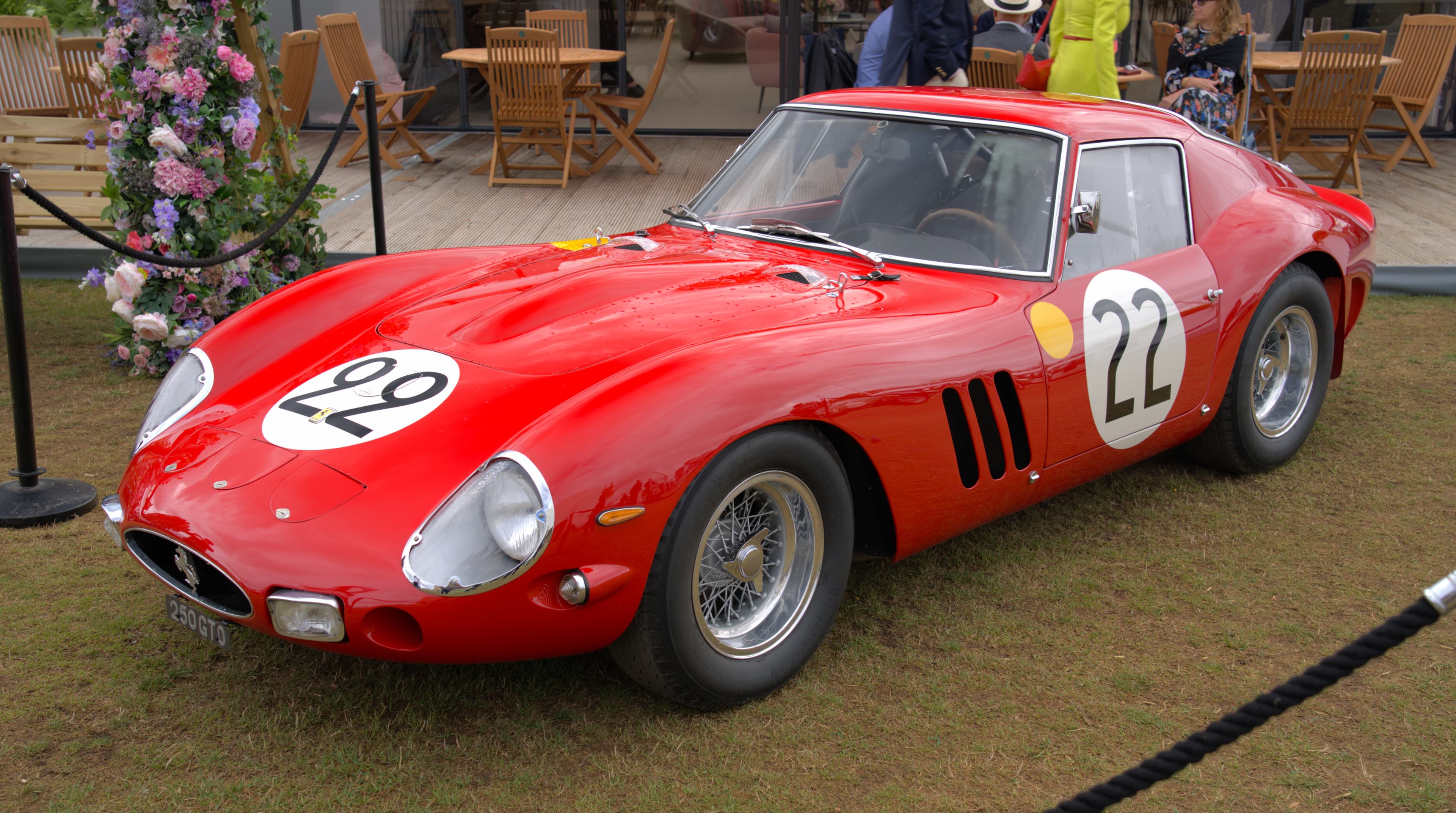
01 / The story
The 250 GTO invites us to look at beauty as an engineering outcome. Its proportions tell a story about air, mechanical packaging and the demands of competition.
Curatorial interpretation
Ferrari developed the GTO for the new GT manufacturers’ championship in 1962. Giotto Bizzarrini’s work addressed the limitations of the preceding 250 GT SWB: aerodynamic lift, frontal area and space for wider tyres. [1]
The letters stand for Gran Turismo Omologato—a grand tourer homologated for competition. Its name places regulations beside performance at the centre of the story. [3]
02 / Design
Follow the body from nose to tail. Each change in profile is an invitation to look more closely.
A revised chassis let Ferrari mount the engine lower. Wind-tunnel work helped shape the extended nose.[1]
Notice the contrast between the long bonnet and the small glasshouse. The proportions make the location of the engine immediately legible.
Visual observationEarly rear spoilers were separate pieces; later coachwork integrated the spoiler into the body.[1]
03 / Engineering
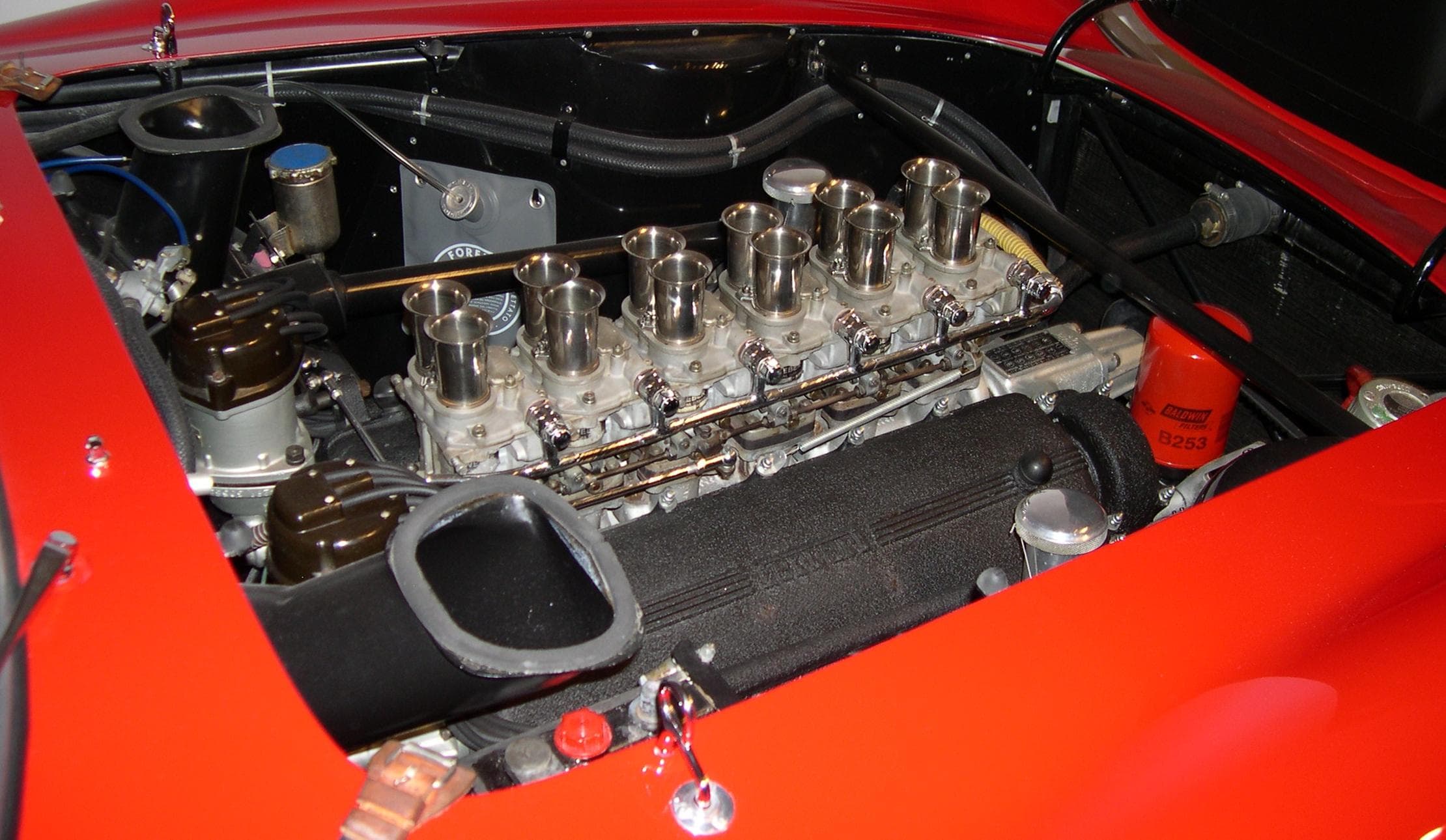
Six carburettors feed the V12, while a five-speed gearbox gives the driver another way to make use of its performance. These details belong in the same story as the bodywork. [1]
The mechanical portrait
Model-level reference. Individual cars changed through racing, repairs and restoration; these are not specifications certified for every chassis.
04 / In time
Four moments connecting the 250 GT family, the GTO’s debut and its continuing development.
The FIA records the Berlinetta 250 GT under homologation number 22, dated 17 June 1960. This is the earlier family record, not a GTO debut date. [2]
At Sebring, Phil Hill and Olivier Gendebien drove the GTO to second overall on its racing debut. [3]
Chassis 3413 took a class victory and fourth overall at the Targa Florio with Gianni Bulgari and Maurizio Grana. [1]
Revised bodywork appeared on the final three GTOs and was also fitted to four earlier cars. Appearance alone cannot establish a car’s build date. [1]
05 / Gallery
Three photographs, different examples.
Select an image to explore.
A 1962 250 GTO at Salon Privé, 30 August 2025. This is a contemporary event photograph, not a period racing image.
MrWalkr · CC BY-SA 4.0Engine photographed at the Museum of Fine Arts, Boston, in 2005, during the Ralph Lauren collection display. A different car from the lead photograph.
Sfoskett (credited on Commons; account Sfoskett~commonswiki) · CC BY-SA 3.0Chassis 3647GT at the Larz Anderson Auto Museum’s Tutto Italiano event. Identification and event context follow the photographer’s description.
ColinMB · CC BY-SA 3.006 / Sources & provenance
This is a model exhibit. It does not claim ownership, authentication or an unbroken history of an individual car. Photographic context, historical evidence and curatorial interpretation are identified separately.
Auction catalogue: development, mechanical changes, 1964 bodywork and the racing record of 3413. A commercial source; chassis-specific claims stay attached to that car.
Consulted 2026-09-12Primary archive for the earlier 250 GT family. Its 1960 date is not presented as the GTO’s introduction.
Consulted 2026-09-12Secondary cross-reference for the production period, configuration, name and Sebring debut. Historical facts are paraphrased; original interpretation is identified separately.
Consulted 2026-09-12A 1962 250 GTO at Salon Privé, 30 August 2025. This is a contemporary event photograph, not a period racing image.
Original source record ↗ · Original photograph ↗
License: CC BY-SA 4.0. Original file retained; responsive display may crop the frame. Any adapted photographic presentation is shared under the same license.
Source and license reviewed 2026-09-12. Attribution does not imply endorsement.
Engine photographed at the Museum of Fine Arts, Boston, in 2005, during the Ralph Lauren collection display. A different car from the lead photograph.
Original source record ↗ · Original photograph ↗
License: CC BY-SA 3.0. Original file retained; responsive display may crop the frame. Any adapted photographic presentation is shared under the same license.
Source and license reviewed 2026-09-12. Attribution does not imply endorsement.
Chassis 3647GT at the Larz Anderson Auto Museum’s Tutto Italiano event. Identification and event context follow the photographer’s description.
Original source record ↗ · Original photograph ↗
License: CC BY-SA 3.0. Original file retained; responsive display may crop the frame. Any adapted photographic presentation is shared under the same license.
Source and license reviewed 2026-09-12. Attribution does not imply endorsement.
End of exhibit / 001


